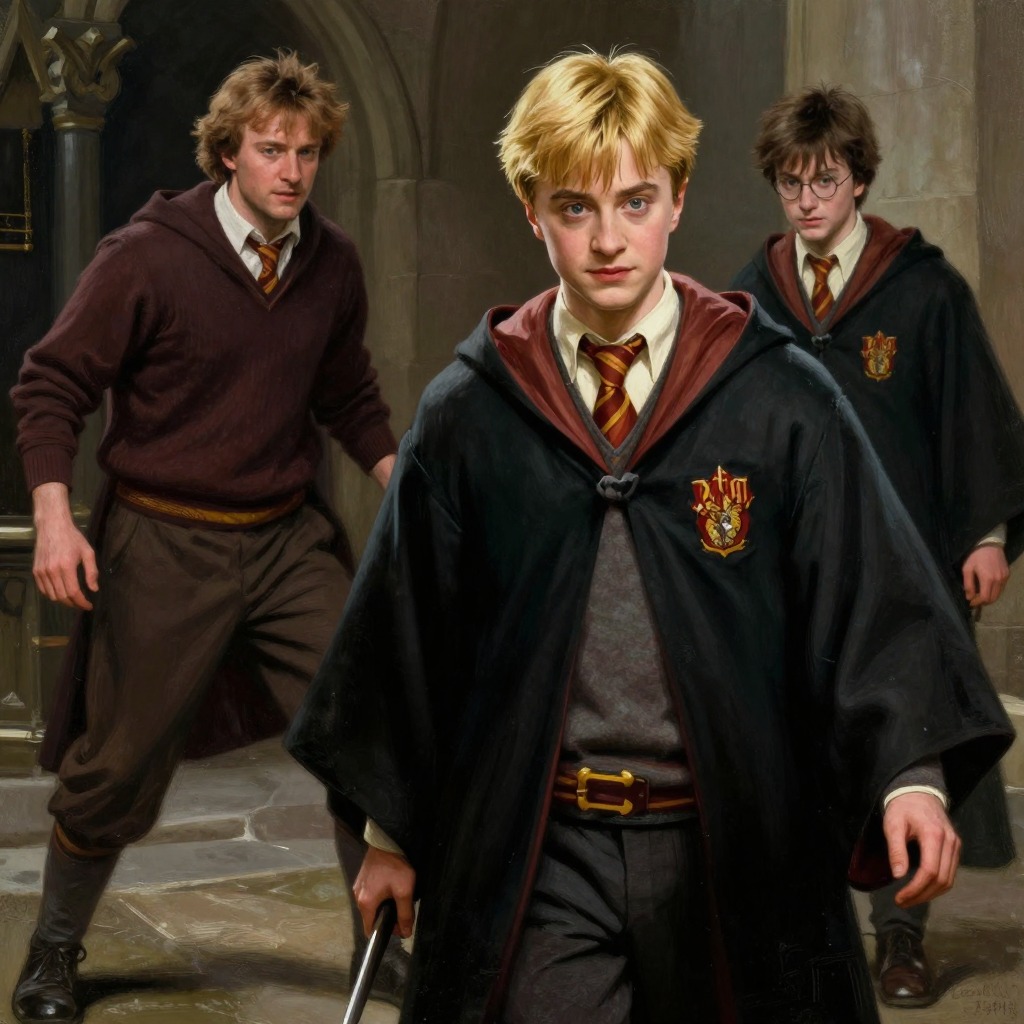
Vincent Crabbe
Vincent Crabbe is a Slytherin student at Hogwarts and one of Draco Malfoy's two primary henchmen, distinguished by his great physical size, thick neck, and pudding-bowl haircut, but notable for his near-total lack of independent initiative or intelligence. Throughout Harry Potter and the Prisoner of Azkaban, Crabbe functions almost exclusively as an extension of Malfoy's will, appearing in scenes of intimidation, bullying, and failed sabotage, yet his presence is so passive that he rarely speaks or acts without direct orders, making him a textbook example of a flat character built around a single idea of brutish, unquestioning loyalty.
Identity and Physical Description
Crabbe is introduced alongside his fellow Slytherin Gregory Goyle as one of the two cronies who flank Draco Malfoy. He is described as wide and muscular, with a very thick neck and a pudding-bowl haircut, a look that marks him as physically imposing but intellectually unremarkable. Unlike Goyle, who has short, bristly hair and long, gorilla-like arms, Crabbe is the taller of the pair, and his appearance alone is often enough to lend weight to Malfoy's threats. The narrative consistently pairs him with Goyle, and the two are rarely seen apart; they seem to exist primarily to do Malfoy's bidding, chuckling trollishly at his insults and looming behind him in confrontations.
Role in the Plot and Key Actions
Crabbe's role in the story is almost entirely reactive. He appears in the Hogwarts Express compartment when Malfoy taunts Ron Weasley about his family's poverty, and he and Goyle chuckle on cue. During the first Care of Magical Creatures lesson, Crabbe is part of the group that takes over the Hippogriff Buckbeak after Harry's successful ride; when Malfoy insults the creature and is attacked, Crabbe and Goyle flex their muscles threateningly at Dean Thomas, who defends Hagrid. Later, in Potions class, Crabbe and Goyle laugh openly at Neville Longbottom's distress when Snape threatens to test his potion on Neville's toad. When Malfoy fakes an injury to his arm after the Hippogriff attack, Crabbe and Goyle snigger at his claims of lasting damage. During the Quidditch match against Ravenclaw, Crabbe is part of the group that, under Malfoy's direction, dons Dementor costumes to try to sabotage Harry, an act that earns them all detention and fifty points from Slytherin. Throughout these incidents, Crabbe never initiates a plan or speaks a line of dialogue that is not a simple echo of Malfoy's malice; his function is to be present, to laugh, and to intimidate by his size alone.
Relationships and Social Position
Crabbe's entire social identity is defined by his subordination to Draco Malfoy. He and Goyle are Malfoy's constant companions, but the relationship is one of command and obedience rather than friendship. Malfoy uses them as muscle, and they follow without question. There is no evidence of any independent thought or personal ambition from Crabbe; he does not seek power for himself, nor does he display any loyalty to Slytherin House beyond that which Malfoy dictates. His bond with Goyle is one of mutual function rather than affection; they are interchangeable parts of Malfoy's entourage. The narrative never shows Crabbe interacting with any other student or teacher on his own behalf, reinforcing his status as a mere appendage to the story's primary antagonist among the students.
Thematic Significance
Crabbe embodies the theme of blind loyalty and the dangers of following without question. In a story where characters like Peter Pettigrew betray their friends out of fear, and where Sirius Black is wrongly condemned by a system that accepts appearances, Crabbe represents the opposite extreme: a follower who never questions, never thinks, and never acts on his own moral judgment. His presence underscores the Slytherin House culture of valuing power and association with the strong, but it also highlights the emptiness of that path. Crabbe is not a villain in his own right; he is a tool, and the narrative treats him as such, giving him no arc, no change, and no moment of choice. His flatness is itself a statement about the kind of person who becomes the muscle for a bully: someone who has surrendered his own agency so completely that he barely exists as a character.